How to Optimize for Google AI Overviews in 2026: 10 Step Guide
A practical 10 step guide to Google AI Overviews: indexing, direct answers, evidence, internal links, and structured data. Informed by our 100 site audit.
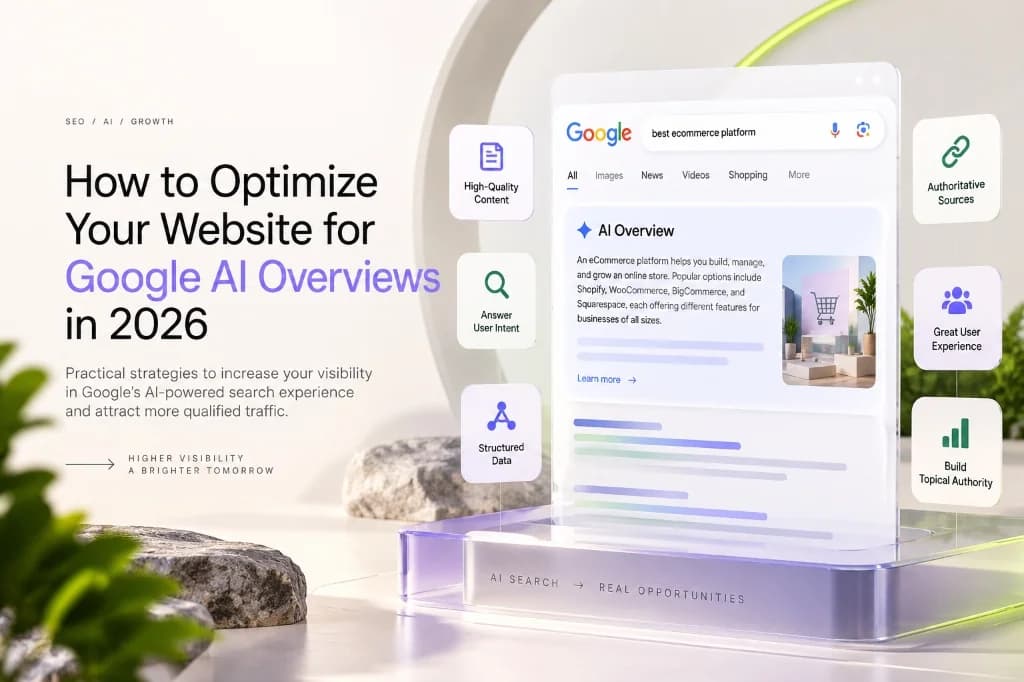
To improve eligibility for Google AI Overviews, make important pages indexable and snippet eligible, answer the question directly, support claims with evidence, and keep structured data consistent with visible content. No special AI markup guarantees inclusion.
Table of Contents
- 1.What Are Google AI Overviews & AI Mode?
- 2.How Does Google Find Sources for AI Search?
- 3.Can You Optimize Specifically for Google AI Overviews?
- 4.What Are People Searching About AI Overviews?
- 5.How to Optimize for AI Overviews: 10 Step Strategy
- 6.What Google Says You DON'T Need (Debunking AI SEO Hacks)
- 7.AI Overviews vs. Traditional Search & Measurement
- 8.Actionable 2026 Google AI Overview Checklist
- 9.Official Google Sources & Further Reading
What Are Google AI Overviews & AI Mode?
Start with pages that can appear in Google Search with a snippet. Answer the specific question early, show the source of important claims, link to related evidence, and check the rendered page for crawl access. Google selects supporting links; no markup guarantees placement. For a tailored implementation, see our AI SEO agency service.
Review the Complete AI SEO framework before applying the Google specific recommendations below.
Google Search is evolving beyond the traditional list of organic results. AI Overviews and AI Mode can help users research complex questions, compare options and explore topics through AI generated responses supported by links to web sources.
What Are Google AI Overviews?
AI Overviews are AI generated summaries that Google may display for searches where its systems determine that an overview can provide additional value beyond traditional search results. These responses can include links to supporting websites so users can explore the subject further.
AI Overviews are particularly useful for questions where users may benefit from information synthesized across multiple sources or concepts. They do not appear for every query. Google determines when an AI Overview adds value to the search experience.
What Is Google AI Mode?
AI Mode provides a more conversational and exploratory Google Search experience. Users can ask longer, more nuanced questions and continue with follow up questions.
Google describes AI Mode as particularly useful for complex questions, comparisons, exploration, reasoning oriented searches, and multi part research. AI Mode responses can include links to websites supporting different parts of the generated response.
From an SEO perspective, this means businesses should think beyond one keyword and one result page. Content needs to provide genuine value across the broader topic surrounding a user's question.
Google states that its established SEO best practices continue to apply to AI features in Search. There is no secret 'AI Overview schema' or shortcut that guarantees inclusion.
How Does Google Find Sources for AI Search?
Google states that AI Overviews and AI Mode are rooted in its core Search ranking and quality systems. Google's generative AI features can retrieve information from its Search index and may use techniques such as retrieval augmented generation to ground generated responses in relevant web information.
Google also describes a technique called query fan out. Instead of relying only on the exact query typed by the user, Google's systems may perform multiple related searches across subtopics and data sources while developing an AI response.
For example, when a user asks: 'What's the best way to improve a Shopify store that gets traffic but isn't generating enough sales?' related information could involve:
• Shopify conversion optimization and product page UX
• Store speed, mobile usability, and checkout friction
• Product descriptions, trust signals, and analytics setup
This is one reason comprehensive topical expertise can be more valuable than repeating one exact keyword throughout a page.
Can You Optimize Specifically for Google AI Overviews?
Yes, but not through a secret AI specific ranking trick.
Google states that the SEO practices used for Search overall continue to apply to AI Overviews and AI Mode. To be eligible as a supporting link, a page must be indexed and eligible to appear in Google Search with a snippet. Google says there are no additional technical requirements specifically for AI Overviews or AI Mode.
That means the practical strategy is: Strong SEO foundations + useful content + clear structure + authority + evidence rather than trying to manipulate a separate AI ranking algorithm.
Indexing and snippet eligibility are technical requirements for supporting links in Google AI Overviews. Meeting them does not guarantee that Google will show or cite the page.
What Are People Searching About AI Overviews?
Search demand is strongly action oriented. In Unified Branding Experts' Search Console data for June 11 through September 8, 2026, related searches included 'how to optimize for AI Overviews,' 'optimize for AI Overviews,' 'strategies to appear in Google AI Overviews,' 'optimizing for AI Overviews,' and 'Google AI Overviews SEO.'
Those query variations produced more than 600 combined impressions but no clicks, with many average positions between roughly 50 and 85. That gap is why this guide now leads with a concise answer, uses headings that match the questions searchers actually ask, and separates documented Google requirements from unproven tactics.
How do you get a brand mentioned in Google AI Overviews?
There is no submission form or guaranteed placement. Build pages that are eligible for Search, answer specific questions clearly, demonstrate relevant experience, cite reliable evidence, maintain consistent organization and author information, and earn independent mentions that corroborate the brand's expertise.
The query observations above come from this site's Google Search Console property. Impressions show demand and visibility, not guaranteed ranking progress or AI Overview inclusion.
How to Optimize for AI Overviews: 10 Step Strategy
Follow these ten practical steps based on Google Search Central guidance to strengthen your website's eligibility for Google AI Overviews and AI Mode:
1. Make Sure Google Can Crawl and Index the Page: Start with basic technical SEO. A page cannot become a useful Google Search source if Google cannot properly access or index it. Important pages should return HTTP 200, be accessible to Googlebot, contain indexable content, use appropriate canonical URLs, avoid accidental noindex directives, be discoverable through internal links, and be included appropriately in XML sitemaps.
2. Satisfy the User's Real Search Intent: Don't optimize content around a keyword while ignoring the actual problem behind the search. Someone searching 'Shopify store not getting sales' probably doesn't want a definition of Shopify, they need actionable guidance on traffic quality, conversion rate, pricing, trust, and checkout friction. Build content around complete user needs.
3. Provide Clear, Self Contained Answers: Users often ask Google increasingly specific and conversational questions. Follow the structured pattern: Question → Direct Answer (40 to 60 words) → Explanation → Evidence → Next Step. For example: Does schema guarantee inclusion in Google AI Overviews? No. Structured data can help Google understand information on a page, but it does not guarantee inclusion.
4. Build Topical Depth (Query Fan Out Optimization): Google's description of query fan out provides another reason to think beyond exact match keywords. A strong website should cover meaningful subtopics surrounding its areas of expertise. A comprehensive pillar like our AI SEO, AEO & GEO Complete Guide connects AI search, AEO, GEO, schema, and measurement.
5. Strengthen Internal Linking: Internal links help users and search engines discover related information. A supporting article should naturally connect to the primary AI SEO pillar, specialized AI SEO services, related ChatGPT Search guides, and empirical AI Search Readiness Study 2026.
6. Use Structured Data Accurately: Structured data remains useful, but it should not be treated as an AI ranking hack. Google says structured data should match visible page content. Useful schema types include Organization, WebSite, WebPage, Article, Service, and BreadcrumbList. Never manufacture fake reviews, fake ratings, or imaginary 'AI Overview schema.'
7. Demonstrate Real Experience and Evidence: Generic statements are easy to reproduce; real experience is harder to replace. Strengthen important content with legitimate case studies, process screenshots, first party data, and expert commentary.
8. Publish Original Information: Google emphasizes unique, valuable, non commodity content in its guidance for AI search experiences. According to UBE's audit of 100 business websites, content retrievability and direct answer formatting averaged only 62.20% of maximum possible framework points. Original research, benchmarks, frameworks, or industry surveys give external publishers and retrieval systems stronger reasons to reference your work.
9. Improve Page Experience and Multimedia: Google specifically recommends maintaining a strong page experience for visitors arriving through classic and AI search results. Prioritize mobile usability, Core Web Vitals performance, clear navigation, and accessible design. Incorporate high quality images and video where they genuinely help explain the topic.
10. Build Authority Beyond Your Own Website: Your website is only one part of your brand's presence online. Strengthen legitimate external authority through editorial backlinks, industry mentions, verified business profiles, interviews, and client references. The objective is independent corroboration.
What Google Says You DON'T Need (Debunking AI SEO Hacks)
There is a growing industry around selling supposed 'AI SEO hacks.' Google's own guidance provides a much more grounded picture:
❌ You Don't Need Special AI Overview Schema: There is no special schema type required to appear in AI Overviews. Use normal supported structured data where it accurately describes visible content.
❌ You Don't Need Special AI Text Files for Google Search: Google does not require a special AI text file as a condition for appearing in AI Overviews or AI Mode.
❌ You Don't Need to Rewrite Every Page as an FAQ: Question and answer structures can be useful when they match user intent, but that does not mean every paragraph needs to become an FAQ.
❌ You Don't Need Hundreds of AI Generated Articles: Mass producing pages without meaningful added value can create quality problems. Google's guidance makes clear that scaled content created without added user value may violate spam policies.
❌ You Don't Need Keyword Stuffing: Modern search systems understand context. Cover topics naturally and comprehensively.
AI Overviews vs. Traditional Search & Measurement
Traditional organic search and Google's AI experiences should not be treated as completely separate ecosystems. Google says its generative AI features are rooted in its core Search ranking and quality systems.
The practical difference is the search experience: Traditional Search surfaces individual web links; AI Overviews synthesize information with supporting links; AI Mode supports deeper exploratory research.
How to Measure Google AI Search Visibility:
Google's Generative AI performance report for Search shows impressions from AI Overviews and AI Mode, with page, country, device and date breakdowns. Google says the report was rolled out worldwide by August 31, 2026, although a property may not show it if it has too few eligible impressions. It does not prove that an individual query generated a lead.
Use the dedicated report when it appears in your property, and compare it with overall Web search impressions, clicks and qualified leads. Record the date of site changes before claiming any effect.
| Measurement Metric | Tracking Source | Target KPI / Outcome |
|---|---|---|
| Generative AI Impressions | Search Console Generative AI Performance Report | Track impressions and pages in AI Overviews and AI Mode where the report is available |
| Classic Organic Search CTR | Google Search Console (Search Type: Web) | Monitor click through rate & snippet performance alongside AI features |
| Branded Search Growth | Google Search Console & Analytics trend analysis | Measure growth in direct brand queries & organic entity recognition |
| Commercial Conversion Rate | GA4 lead events and CRM records | Evaluate qualified leads from organic search without assigning an unsupported AI citation source |
Actionable 2026 Google AI Overview Checklist
Use this 5 stage checklist to evaluate your website's readiness for Google AI Overviews and AI Mode:
✓ Technical: Verify Googlebot access, HTTP 200 status, indexability, canonical tags, and XML sitemap health.
✓ Content & Intent: Add 40 to 60 word self contained answers under key headings and cover subtopics matching query fan out patterns.
✓ Entity & Trust: Implement valid Organization schema linking core capabilities, team, and verified profiles.
✓ Proof & Authority: Publish citation worthy original data and earn independent editorial mentions.
✓ Analytics: Monitor Search Console Generative AI reports using specialized AI SEO services and transparent AI SEO growth packages.
Official Google Sources & Further Reading
For authoritative documentation directly from Google Search Central, consult these official resources:
• Google Search Central: Optimizing your website for generative AI features on Google Search, Official Google guidance on Search technical requirements, snippet eligibility, and supporting links.
• Google Search Central: AI features and your website, Overview of how Google Search incorporates generative AI and links to supporting web sources.
• Google Search Central: Top ways to ensure your content performs well in Google's AI experiences, Key recommendations on helpful content and clear page structure.
• Google Search Console Help: Generative AI performance report (Search), Official documentation on tracking AI Overviews and AI Mode impressions.
• Google Search Central: Google Search's guidance about generative AI content, Standards on content quality, added user value, and search spam policies.
• AI SEO, AEO & GEO: Complete Guide for 2026, Unified Branding Experts primary authority framework for AI search optimization.
Optimize Your Website for Google AI Search
Our AI SEO architects engineer entity schemas, Search Central compliance, and query fan out content clusters.
AI SEO & Search Growth Packages
Compare our transparent tiers with full deliverables, timelines, and 100% ownership.
Frequently Asked Questions
Can I guarantee my website will appear in Google AI Overviews?
No. Meeting Google's technical requirements and best practices does not guarantee that Google will crawl, index or display a page in a particular search feature.
Does Google have a special AI Overview ranking algorithm I can optimize for?
Google does not provide a separate public formula that marketers can manipulate for guaranteed AI Overview placement. Its official guidance emphasizes established SEO foundations, useful content and Search eligibility.
Do I need special schema for Google AI Overviews?
No. Google states that there are no additional technical requirements specifically for AI Overviews or AI Mode. Use accurate supported structured data when appropriate.
Does llms.txt help Google AI Overviews?
Google does not require llms.txt for AI Overview or AI Mode eligibility. Focus on Google's established Search crawl and indexing requirements.
Are backlinks still relevant?
External links and mentions remain useful components of broader SEO and authority building. Do not treat backlinks as a guaranteed AI Overview trigger.
Can I track AI Overview impressions?
Yes. Google's Generative AI performance report shows impressions for AI Overviews and AI Mode. Google says it rolled out worldwide by August 31, 2026; a property may still not show the report if it has too few qualifying impressions.
What are the best strategies to appear in Google AI Overviews?
Start with crawlability, indexability and snippet eligibility; answer the search intent directly; add verifiable evidence; cover related subtopics; use descriptive internal links; keep structured data accurate; and improve authority through legitimate third party mentions. None of these steps guarantees inclusion.
Does adding schema guarantee a place in Google AI Overviews?
No. Structured data can clarify visible information, but Google chooses when to show an AI Overview and which sources to cite.
Do I need special AI Overview markup?
No. Google says its established Search guidance applies to AI features, including crawlability, indexing and snippet eligibility.
Can a page blocked from indexing appear as an AI Overview source?
A page must be indexed and eligible to appear with a snippet in Google Search to be eligible as a supporting link in Google's AI features.
How long will AI Overview optimization take?
There is no fixed timeline. After changes, allow for crawling and indexing, then review relevant search queries, qualified traffic and leads over time.
Unified Branding Experts Editorial & Strategy Team
Unified Branding Experts is a full service digital branding, technology, and growth agency. We combine brand identity, full stack Next.js, high velocity eCommerce, and AI Search Optimization into one connected scaling system.
Related Insights & Strategy Guides
View All Articles →AI SEO, AEO & GEO: Complete Guide for 2026
Learn how AI SEO, AEO and GEO help businesses improve visibility across Google AI Overviews, ChatGPT, Gemini and other AI powered search experiences.
How to Get Your Business Mentioned in ChatGPT: 9 Steps for 2026
Learn 9 practical ways to improve your business's eligibility for discovery, mentions and citations in ChatGPT Search, from OAI Search Bot access to content authority.
How Much Does a Small Business Website Cost in 2026?
A comprehensive guide to small business website costs in 2026. Compare DIY builders ($15 to $40/mo), custom agency websites ($300 to $1,200), and custom web applications ($1,500 to $5,000+).