Happy Knot Creations Shopify Store Case Study
Shopify storefront, store management, and AI SEO for a handmade crochet and custom amigurumi business.
Visit Live SiteThe Client
About Happy Knot Creations
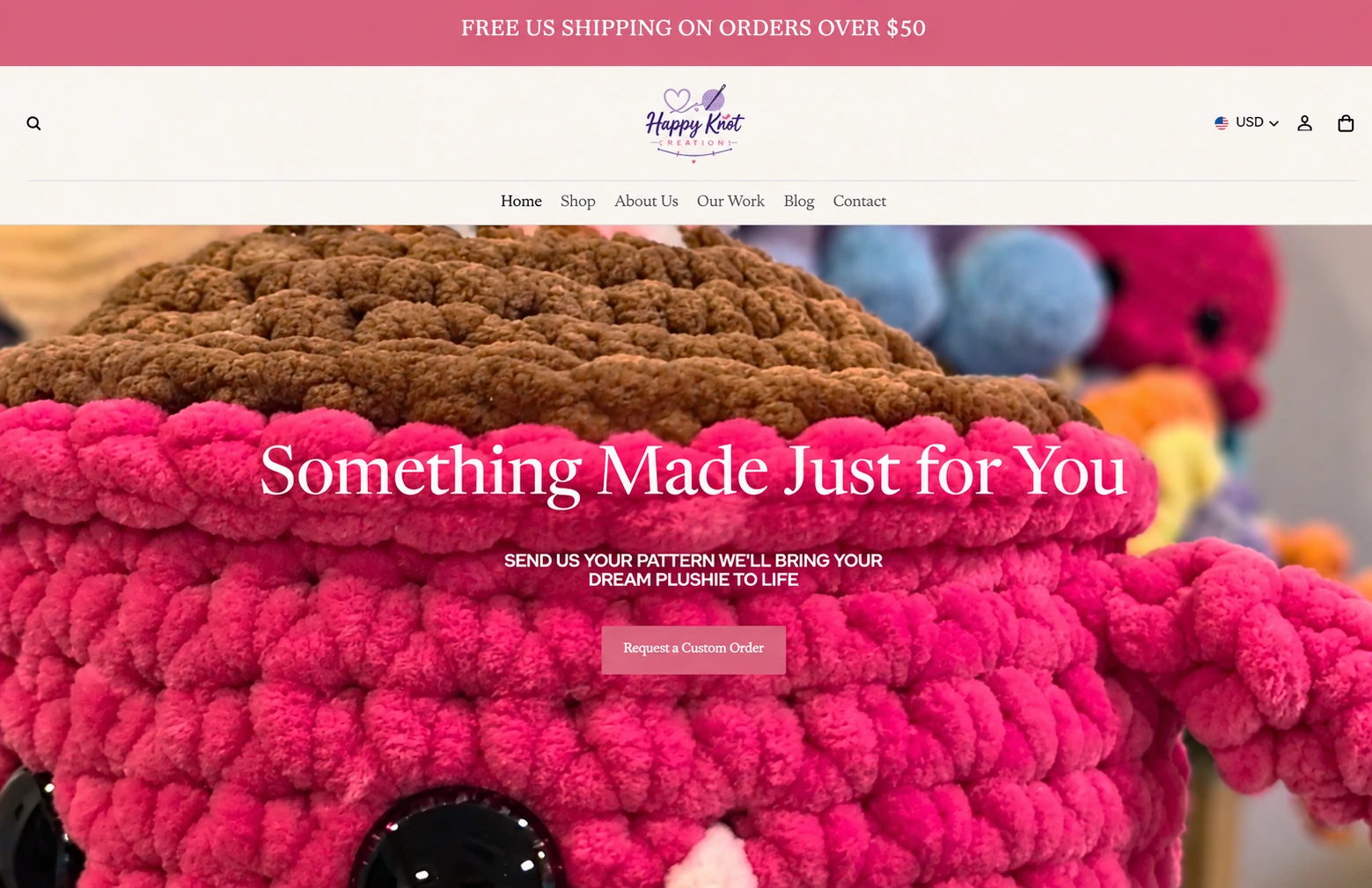
Happy Knot Creations is a handmade crochet business based in Pahrump, Nevada. Its storefront presents made to order amigurumi, ready to shop plushies, themed collections, and crochet gifts.
The Challenge
The live store serves two distinct shopping needs: customers can browse finished handmade items or start a custom order conversation. Product groupings such as Ocean Friends, Animal Friends, Custom Friends, and Gifts for Crocheters help visitors narrow a varied handmade catalog without treating every item as the same kind of purchase. The project brief supplied by UBE identifies Shopify build, store management, and AI SEO as the scope; no prior platform migration or sales challenge is documented.
Strategic Direction
The current store makes two buying paths visible: browse ready to buy handmade products or start a custom order conversation. Its navigation also groups products by theme and customer interest. UBE’s confirmed scope for this project is Shopify storefront work, ongoing store management, and AI SEO. This case study does not claim a marketplace migration, custom checkout, or specific third party integration without project records to support it.
What UBE Built
The current Shopify experience includes collection pages, product detail pages with product imagery and purchase controls, a custom order route, review content, and business information about the maker and order fulfillment. UBE's owner provided scope also includes ongoing store management and AI SEO. Specific theme code changes, schema deployments, packaging work, and social media deliverables are not included here because they have not been independently documented.
The Client
Happy Knot Creations is a handmade crochet business based in Pahrump, Nevada. Its current Shopify storefront presents ready to shop plushies alongside custom order entry points, giving visitors a way to browse available work or ask about a made to order piece. The products and imagery on the live site show a small batch, maker led catalog rather than a mass produced toy range.
This case study focuses on the digital commerce system and the visible customer experience. It does not imply that UBE designed the crochet products, authored customer reviews, or controls the production capacity and fulfillment schedule. Those details belong to the business and can change as its catalog and availability change.
The Challenge
A handmade catalog asks shoppers to make several decisions before they can confidently place an order. They need to distinguish an item that is currently available from a custom request, understand what kinds of products the maker offers, and find enough detail to decide whether a particular plush or gift suits their needs. A storefront that treats every product as one undifferentiated list makes that discovery harder, especially when the catalog includes different characters, themes, and purchase expectations.
Custom work creates a second interaction pattern. A ready to buy product can use the familiar product page and cart flow; a made to order request may require a conversation about the desired character, timing, or other details. The site therefore needs to make the distinction understandable without presenting a custom request as if it were an immediately available item. The live store now exposes both product browsing and custom order routes. This description refers to what visitors can see; it does not assert a specific internal production workflow or turnaround time.
The business also has to communicate the character of handmade work through the screen. Product photographs, collection names, descriptions, maker information, and support details each help set expectations. These elements should work together: imagery introduces the item, collection structure helps the shopper orient, and product level information supports the purchase decision. On mobile, where many visitors encounter a store in a narrow viewport, these paths must remain understandable without relying on hover behavior or dense navigation.
UBE’s owner provided project scope identifies three connected responsibilities: Shopify storefront development, ongoing store management, and AI SEO. No project analytics, baseline rankings, sales figures, or conversion data were supplied for this case study. The challenge is therefore described as a commerce and discovery problem, not as a claim that the business had a particular revenue, traffic, or search performance issue.
What UBE Built and Managed
UBE’s confirmed work includes a Shopify storefront for the business. The current public experience gives shoppers access to a homepage, themed product collections, individual product pages, cart and purchase controls, business information, and a custom order path. These are the visible storefront areas a prospective customer can review today. The case study does not attribute every current detail to a particular custom code change because implementation records identifying theme edits or application settings were not available for this write up.
The collection structure helps visitors browse by interest instead of needing to know a specific product name first. Current navigation and collection content include groupings such as Ocean Friends, Animal Friends, Custom Friends, Fantasy Friends, and Gifts for Crocheters. These labels establish useful entry points for different shopping intentions: find a particular style, explore a theme, consider a custom creation, or shop for someone who crochets. Collection names and availability may evolve with the maker’s catalog, so this page describes the public site observed during review rather than promising a fixed inventory.
Product pages provide the next level of decision support. Shoppers can view product imagery and the purchase controls associated with an item, then continue into the store’s cart flow. For a handmade catalog, the product page is where the broad story of the collection meets the specific item under consideration. Clear photography and product specific information matter because the customer is evaluating an individual crafted object, not a generic SKU with no visual distinction.
The project scope also includes ongoing store management. That is an owner confirmed service responsibility, but the records provided do not enumerate a dated task log, specific publishing cadence, or every managed product change. We therefore describe the service at the confirmed level and do not invent a number of listings updated, campaigns launched, or hours of support. This distinction keeps the case study useful without converting a service category into an unsupported performance claim.
AI SEO is the third owner confirmed part of the scope. The current website can be explored by people and crawlers through its public pages and descriptive collection/product content, but the evidence available for this story does not establish which structured data changes, page level optimizations, or indexing outcomes UBE implemented. We do not claim that the site has been cited by a particular AI answer engine or that a ranking improved. The case study records AI SEO as project scope and leaves outcome measurement for a future version if dated implementation records or Search Console data become available.
How the Work Maps to The Unified System™
The Unified System™ is UBE’s current four stage model: Brand, Build, Launch, and Scale. The available project brief confirms storefront development, management, and AI SEO, but it does not provide dated project notes proving that every stage was delivered in a particular sequence. The mapping below is an editorial way to explain how these confirmed responsibilities fit together; it is not a claim that a complete brand identity or a specific four stage engagement was separately commissioned.
Build is the clearest documented connection: the Shopify storefront gives the business a place to present its catalog and accept online orders. The live experience includes collection discovery, product detail pages, a cart flow, and a route for custom inquiries. This is the foundation on which product presentation and ongoing store operations can be organized.
Launch describes the discoverability layer. AI SEO is part of the scope supplied by UBE, but no implementation checklist or measured search outcome was provided. The responsible conclusion is that search optimization was included as a service area, while exact technical deliverables and visibility changes remain unverified in the evidence available for this case study.
Scale connects to ongoing management: a handmade business can update its catalog and customer facing information as products and availability change. UBE confirms store management was included, but this page does not imply a guaranteed sales trajectory, a defined monthly volume of updates, or a specific retention period. Brand remains a supporting consideration expressed through the maker’s own product identity and photography; a separate UBE brand identity package is not claimed here.
Visible Storefront Evidence and Limits
The current public storefront provides observable evidence of the shopping experience: themed collections, product imagery, product pages, purchase controls, custom order information, reviews displayed by the merchant, and maker/business information. These are descriptions of the live site at the time this case study was prepared. Reviews shown on the merchant’s website are not presented as UBE testimonials, and no review markup or rating claim is added here.
No verified before and after analytics, revenue, order count, average order value, organic impressions, search positions, conversion rate, or traffic report was supplied. For that reason, this case study reports the deliverable categories and current storefront structure rather than a numerical business result. Store performance also depends on factors outside a build or management engagement, including product demand, pricing, available stock, fulfillment, customer service, and ongoing promotion.
The strongest next evidence for a fuller results section would be an owner approved project timeline, implementation notes, a list of specific management tasks, and permissioned analytics or Search Console comparisons. Until those records are available, the live site and UBE’s confirmed scope are the boundaries of what we claim.
Discuss a similar Shopify project
If you need a Shopify storefront, ongoing store management, or search support for a product catalog, review our Shopify development service or tell us about your project.
Discuss a Similar ProjectSelected for optimal brand legibility, visual hierarchy, and cross platform consistency.