The Barcode Lady WooCommerce Website Case Study
A product-led website and store for barcode hardware and labeling supplies, supported by content, graphics, AI SEO and management.
Visit Live SiteThe Client
About The Barcode Lady
The Barcode Lady sells barcode and RFID printers, scanners, labels, ribbons, price guns and related supplies, and provides product guidance and setup support. Its public site combines a store with category and service information.
The Challenge
A business selling labels, scanners, printers and inventory tools needs to serve both a buyer who knows a product category and a visitor who needs help choosing a solution. The site must make equipment, consumables, custom services and quote paths distinct while keeping them connected.
Strategic Direction
Separate equipment and supply discovery from consultative service paths, then support both with category content, product graphics and clear calls to contact or shop. UBE's scope includes store creation, content, graphics, AI SEO and management; exact catalog migrations, plugin choices and performance outcomes require separate records.
What UBE Built
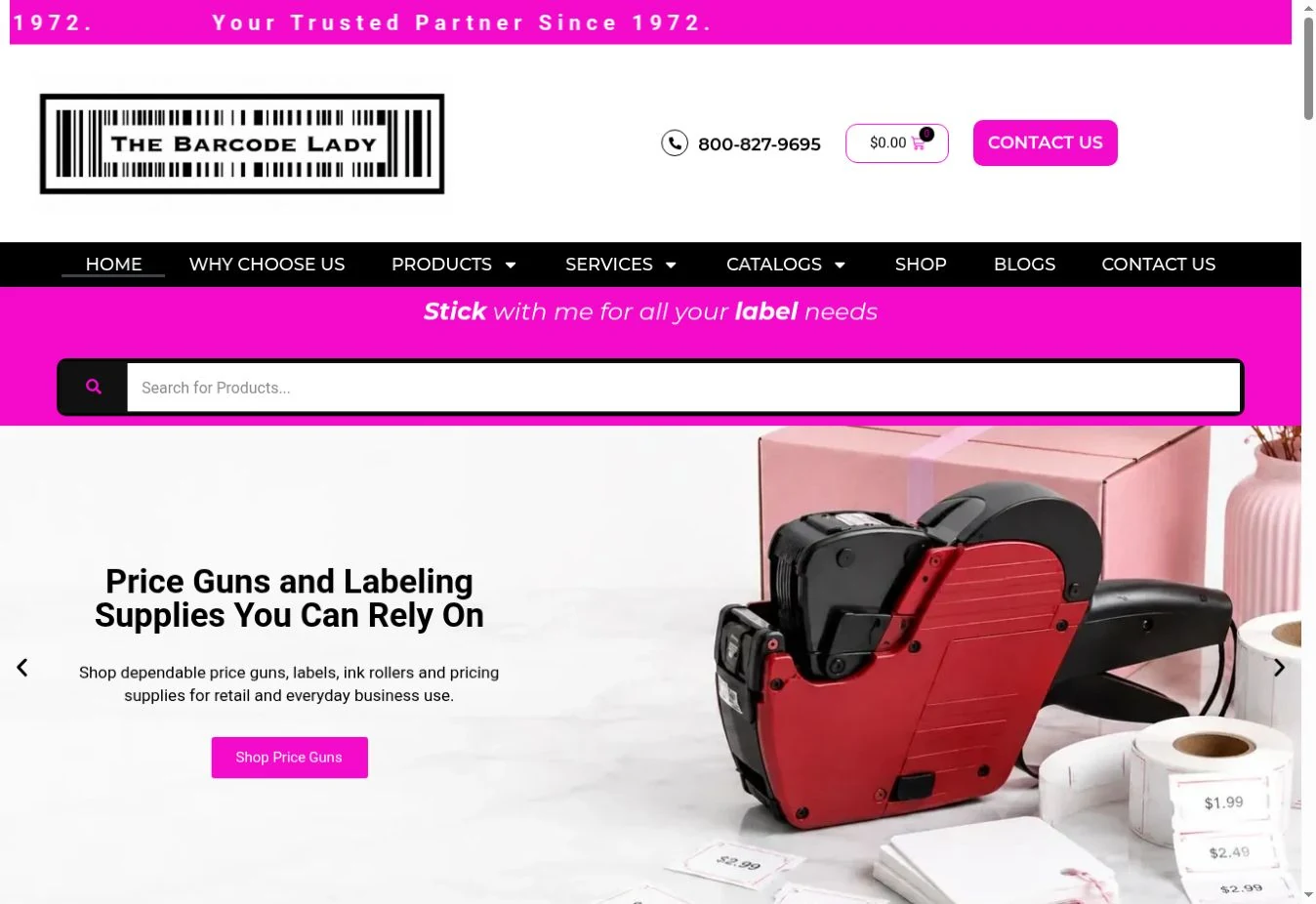
The live site provides a shop, product-category navigation, pages for printers, scanners, labels and custom solutions, a prominent product search and contact route. Its hero presents barcode and labeling equipment together. UBE's design-and-management credit appears in the public footer; the owner additionally confirms product graphics, content and AI SEO.
The Client and the Product Landscape
The Barcode Lady serves businesses that need barcode and labeling equipment and supplies. Its public catalog covers printers, scanners and portable data collectors, RFID products, labels, tags, ribbons, price guns and warehouse labeling. The site also presents custom label printing and inventory-system setup as service paths. A retail operator looking for pricing labels and a warehouse buyer researching RFID equipment do not arrive with the same question, so the website needs a useful route for each.
The live site is a business website and shop rather than a single product landing page. Its header has navigation into Products, Services, Catalogs, Shop, Blogs and Contact Us. A prominent search field offers another way into the catalog. The home page moves from a visual introduction of barcode hardware to product and service categories, support information and a contact path. These elements are observable on the current site.
UBE confirms website and store creation, product graphic and content creation, AI SEO and management. The Barcode Lady's footer also links to Unified Branding Experts with a design-and-management credit. That public attribution supports the relationship, but it does not specify the number of products built, a migration history, all plugins installed or the performance of any campaign.
The Challenge: Connect Products to Practical Business Needs
Barcode supplies cover several tasks that can sound similar until a buyer reaches the specifications. A label printer and a scanner are different tools; RFID tags, ribbons, warehouse labels and custom printed labels solve different operational problems. A customer may know the exact item needed, or may be trying to identify the right class of solution. The information architecture has to accommodate both direct product shopping and a request for expert guidance.
The business also serves organizations whose buying process may be consultative. A visitor comparing a complete inventory setup may need to understand the available equipment and then contact someone before choosing it. The live site supports this with dedicated service pages and calls to get a quote or contact the business. Those contact routes should sit alongside the shop, not be buried inside a product grid.
Product graphics have a different role here than in a lifestyle-apparel store. A shopper benefits from seeing the form of a printer, handheld scanner, label roll or other piece of equipment, while product copy needs to explain the actual application. UBE confirms product graphic and content creation as a workstream. Without an approved asset inventory, we avoid assigning authorship of every current manufacturer image or claiming that all visible specifications were newly written by UBE.
No approved before-state or private analytics were supplied. This case study therefore describes the catalog-navigation and information problem visible from the public assortment, not a measured previous bounce rate, lost-sales figure, search-ranking issue or conversion uplift.
Website, Store, Content and Graphics
UBE's confirmed work includes creation of the website and store. The current WordPress and WooCommerce experience offers a public Shop route and category pages for barcode and RFID printers, scanners, labels, tags, ribbons, warehouse labels and price marking supplies. The home page groups these routes under Barcode and Labeling Products and then explains how the products support point-of-sale and inventory workflows.
The desktop hero shows a printer, scanner, portable device, labeled box and rolls of labels next to a direct shopping call to action. The site places the search field above that visual, letting someone with a known product need act quickly. Farther down, category links, service descriptions and contact prompts serve visitors who need more context. A customer can move from a broad problem to a product category or from a specific item to the shop.
UBE confirms product graphics and content work. Useful copy for this assortment should identify what an item is used for, distinguish supply types and give enough detail for a buyer to decide whether to keep browsing or ask for help. The live site contains category explanations, product pages and service content. We do not claim a specific number of descriptions, graphics or custom templates because a production log was not provided.
The site also offers information about custom labels, equipment setup and technical support. Those pages matter because the business sells solutions as well as individual items. Its visible brand presentation uses a distinctive barcode wordmark and magenta accents. The footer's UBE credit substantiates design and management involvement, while the exact scope of original identity design remains outside this case study unless separately documented.
AI SEO and Continued Management
UBE confirms AI SEO work for The Barcode Lady. The public site has descriptive routes for several equipment and supply categories, service pages for related solutions and supporting blog content. A structured set of pages can help people and search systems understand the difference between a barcode printer, an RFID label and a custom service. But the public pages alone do not establish which JSON-LD blocks, technical fixes, indexing requests or AI-answer citations were delivered by UBE, so none is claimed as a specific result.
The owner also confirms continuing site and store management, and the live footer directly credits UBE for design and management. A large B2B catalog needs care as products, service information and availability change. The case study does not infer a service-level agreement, exact monthly hours, number of products maintained or support-ticket volume from that credit.
The Unified System™ describes Brand → Build → Launch → Scale. For this project, the visible brand presentation supports the customer-facing system, website and store creation fit Build, content and AI SEO fit Launch, and ongoing management fits Scale. This is a present-day explanation of how the confirmed workstreams connect. It is not a claim that all four stages were sold or documented as a separate package.
Visible Deliverable and Evidence Limits
A prospective client can inspect the current site, navigate from broad product groups into specialized categories, explore the shop and find contact routes for consultative work. The public experience demonstrates a combined commerce and information website for a technically varied assortment. The UBE credit in the footer is a visible confirmation of its design-and-management relationship with the client.
No approved revenue, lead, organic-traffic, sales, quote-request, conversion or ranking data was made available for publication. This case study therefore reports the site and UBE-confirmed work categories rather than an invented business outcome. Statements on the client's site about its own history, reviews and guarantees belong to the client and are not republished here as UBE performance proof.
A future evidence-backed update could include the launch timeline, an approved list of products and graphics produced, a record of SEO implementation and permission to share anonymized analytics. Until that material exists, the current public website and UBE's confirmed scope are the limits of the story. For current product specifications and availability, visitors should consult the live merchant site.
This distinction is especially useful for a business-to-business catalog. A case study can demonstrate how a prospective buyer reaches the right product group and where a question becomes a contact inquiry, even when no conversion dataset is public. The current navigation, search field, category pages and service routes provide inspectable examples of those decisions. A visitor evaluating UBE can follow those routes directly and judge the information architecture in context. The site should be assessed for the task it performs: explaining a technical assortment and giving customers sensible paths to shop or request guidance. It should not be treated as evidence of an unstated increase in leads or revenue.
Explore the related UBE work
This project combines store creation, product presentation, search support and management. See how those services are scoped for a new project.