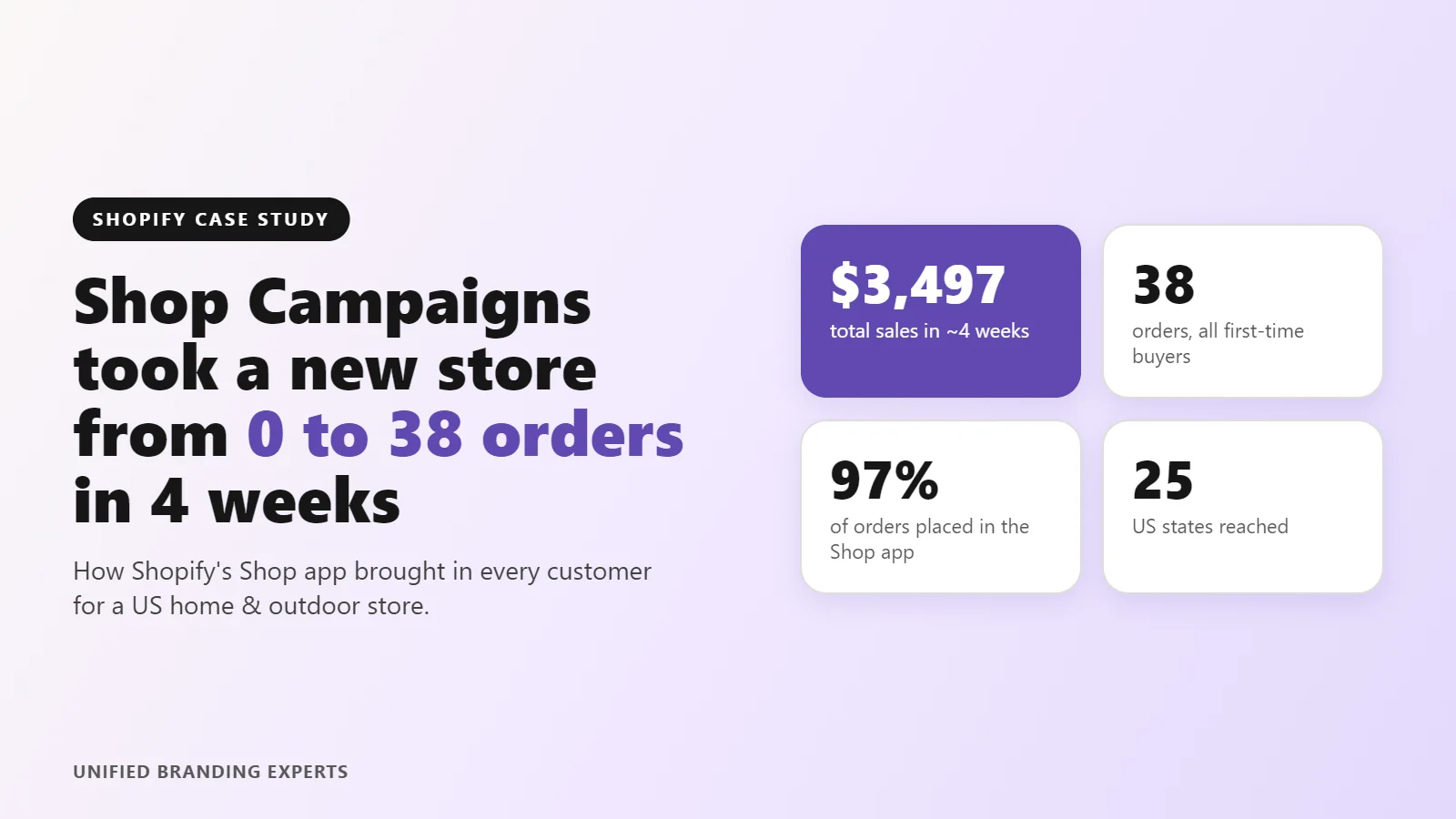
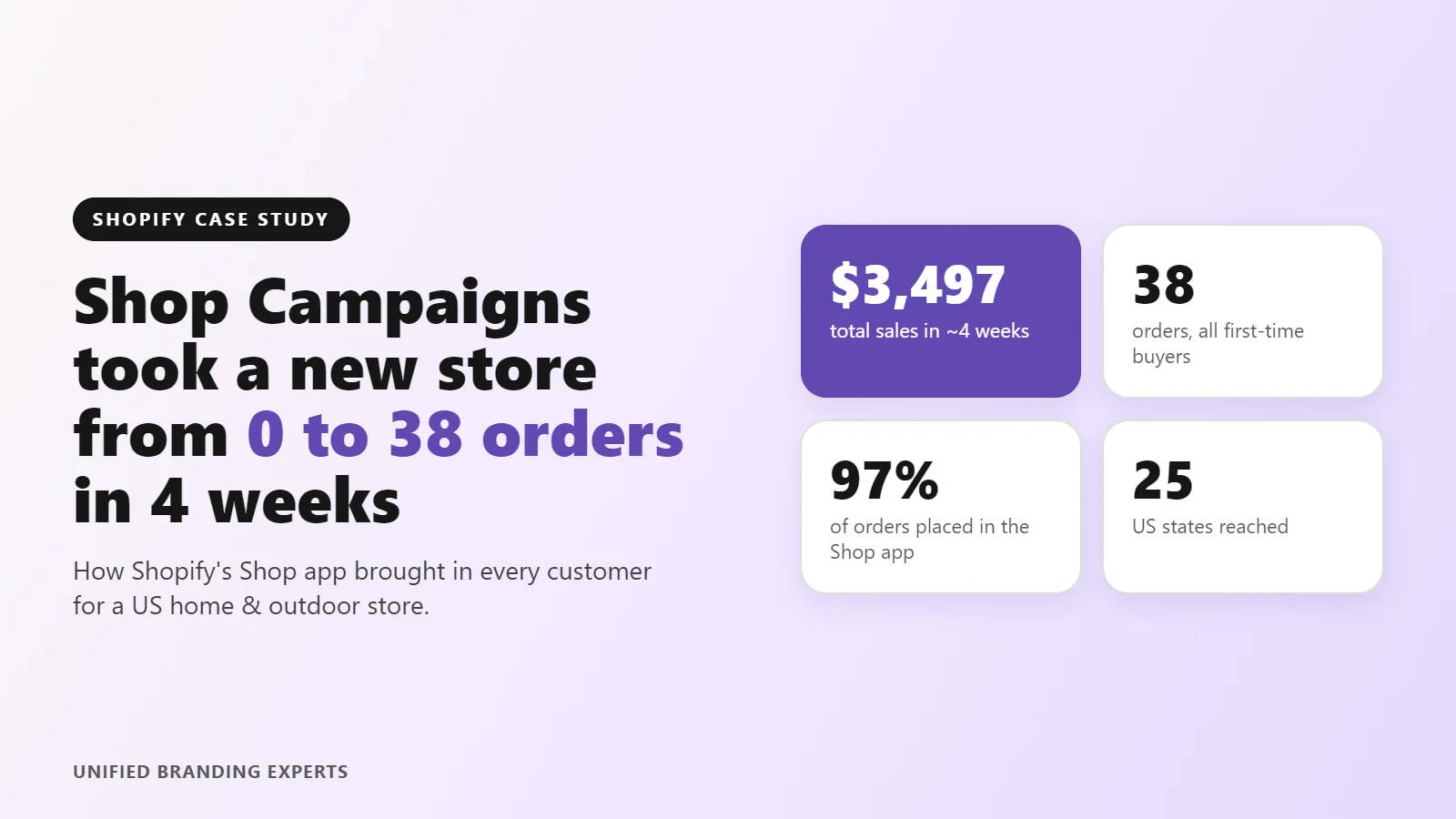
Shopify Shop Campaigns Case Study: 0 to 38 Orders in 4 Weeks
How Shopify's Shop app and Shop Campaigns turned nine weeks of zero sales into 38 paid orders and $3,497 in sales in about four weeks, with 97% of orders placed inside the Shop app.
The Client
About Confidential Shopify Client
The client is a US-based Shopify store selling outdoor, camping and home essentials. At the client's request, the store name, web address and all customer details are kept confidential. Every figure on this page comes from the store's own Shopify analytics and order records for the period August 17 to November 17, 2026.
The Challenge
The store was live, stocked and ready, but nobody was buying. From mid-August to mid-October 2026 it recorded zero orders for nine weeks. Social media sent only about 57 sessions from Facebook, Instagram, Pinterest, TikTok and X combined, and none became a sale. A one-day spike of roughly 500 sessions in September also produced no orders, and the store had no repeat buyers to fall back on.
Strategic Direction
The store needed buyers who were already in a shopping mindset, not more casual visitors. Shopify's Shop app puts products in front of shoppers who are actively browsing and buying, and Shop Campaigns charge for new customers acquired, with a Shop Cash offer on the first purchase. That made the Shop app the most direct route to first-time buyers for a new store with no audience.
What UBE Built
The Shop Campaign went live in the week of October 19 and orders started that same week. UBE then audited every order in the store backend, checking the sales channel, the app that created each order, referrer and UTM data, and the tags Shopify attached, so the store could see exactly which channel was producing customers and stop judging performance by website sessions alone.
Where the customers came from
UBE reviewed every order rather than relying on the analytics dashboard. 34 orders (89%) came from the Shop app through the Shop Campaign and were tagged by Shopify as New campaign, New customers and Shop Cash offers acquired. 3 orders (8%) came from shoppers who found the store inside the Shop app without the offer. The single remaining order (3%) was placed on the online store, and even that visit started on shop.com and checked out with Shop Pay.
No order carried a Facebook, Instagram, Google or other ad referrer or UTM tag. In other words, 100% of the store's orders trace back to Shopify's Shop ecosystem, and about $3,450 of the $3,497 in sales was placed inside the Shop app itself.
Why the store's analytics looked broken
The Shopify dashboard showed a 0.1% conversion rate and None as the referrer for almost all sales. That looked like a store that was not converting. It was not. Shop app orders are placed inside the app, not on the store's website, so they never appear as website sessions and they arrive without a website referrer.
The sales-by-channel report told the real story: about $3.4K from the Shop channel against $48.94 from the online store. Store owners who judge a Shop Campaign by website conversion rate or the referrer report will undercount it. The sales channel field and Shopify's order tags are the reliable source of truth.
Week-by-week growth after launch
From August 17 to October 12 (nine weeks) the store had 0 orders and $0 in sales. The week of October 19 brought 2 orders and $128.85. The week of October 26 brought 9 orders and $500.66. The week of November 2 brought 10 orders and $430.45. The week of November 9 brought 15 orders and $2,245.53, and the first two days of the week of November 16 added 2 orders and $191.77.
The best week included the store's largest sale, a $1,228.14 portable power station with a solar panel, also placed through the Shop Campaign. Without that one order, the other 37 orders still average about $61 each, which is a healthy order value for first-time buyers.
Who bought and what sold
The 38 orders shipped to 25 different US states. California led with 4 orders, followed by Florida, New York and Texas with 3 each, Arizona, Maryland, Hawaii and Pennsylvania with 2 each, and 17 more states with one order each. Every customer was a first-time buyer, which is exactly what Shop Campaigns are designed to deliver.
Sales were spread across the catalog instead of depending on one product: portable power and solar (the highest-value orders), storage and organization (heavy-duty totes were the most repeated item with 3 orders), camping gear such as cots, stoves, air mattresses and chair umbrellas, fishing electronics and tackle, kitchen and home items including stainless steel cutting boards (3 orders) and paper shredders (2 orders), and home fitness equipment.
Order quality held up: 35 of 38 orders were fulfilled, and refunds totalled $195.78, under 6% of gross sales, across 3 orders.
Key takeaways for Shopify store owners
1. The Shop app is a real customer acquisition channel. For a new Shopify store with no audience, Shop Campaigns brought in 34 paying customers in four weeks, where nine weeks of social traffic brought in none.
2. Track the right source. Shop app orders do not show up as website sessions, so website conversion rate and referrer reports undercount this channel. Order tags and the sales channel field show the true picture.
3. High-ticket products sell here too. A $1,228 order came through the campaign, so the channel is not limited to low-cost impulse items.
4. A wide catalog helps. Sales came from six product categories and 25 states, so growth did not depend on one bestseller or one region.
What comes next
The recommended next stage is turning first-time buyers into repeat customers with follow-up emails, Shop app follows and a second-order offer, which can lift the current 0% returning customer rate, while continuing to scale the Shop Campaign as long as it keeps acquiring new customers profitably.
The plan also adds a second acquisition channel, using retargeting of past buyers and lookalike audiences, so growth does not depend on one platform, and features the proven winners (power stations, storage totes and cutting boards) in the store and in campaign creatives. For a step-by-step look at how Shop Campaigns work and how to set one up, read our Shopify Shop Campaigns guide.
Explore the related UBE work
This project combines store creation, product presentation, search support and management. See how those services are scoped for a new project.
Project visuals
Project Gallery